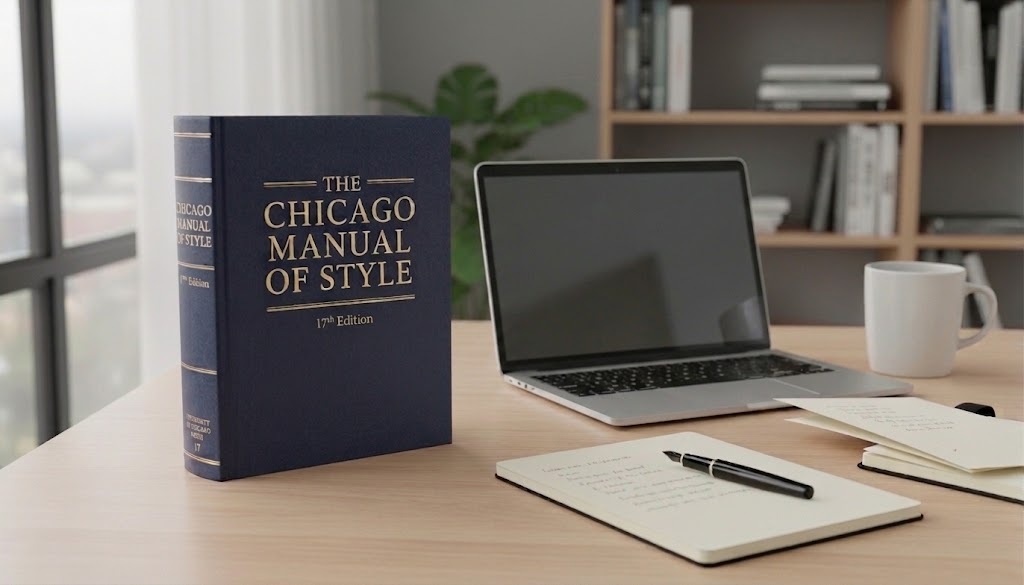
If you are writing a paper in history, literature, art, or the social sciences, chances are you've been asked to follow the Chicago Manual of Style (CMOS). And if you've spent more than five minutes looking through the rulebook, you already know how overwhelming it can feel.
Unlike other academic styles that stick to one simple format, Chicago gives you options—and a lot of specific rules to track. But getting your citations right doesn’t have to drain all your energy. Here is a clear, straightforward guide to mastering Chicago style so your manuscript looks clean, professional, and ready for publication.
1. Know Your System: Footnotes or Parentheses?
Before you write your first reference, you need to know which of the two main Chicago systems your discipline or university requires:
Notes and bibliography: Popular in history and the humanities, this method uses small superscript numbers in your text that point to footnotes at the bottom of the page (or endnotes at the end of the chapter). It also includes a full bibliography at the very end of your paper.
Author-date: Widely used in the social sciences, this approach places brief citations in parentheses (such as Smith 2023, 45) that match a complete reference list at the end of your paper.
Pro tip: Choose the system approved for your field and stick to it strictly. Mixing elements from both is one of the most common mistakes writers make, and it instantly disrupts the flow of your paper.
2. Say Goodbye to "Ibid."
If you’ve used Chicago style in the past, you probably remember using "Ibid." whenever you cited the same source twice in a row.
Here is the big update: recent editions of the Chicago manual officially discourage using "Ibid."
Because digital texts reflow across different screen sizes, "Ibid." often gets separated from the original source, confusing the reader. Instead, Chicago now asks for a shortened note for all repeated sources. That means listing just the author’s last name, a shortened title, and the page number.
First citation: Jane Doe, Understanding History (New York: Academic Press, 2020), 88.
Next citation: Doe, Understanding History, 88.
3. Footnotes vs. Bibliography: Mind the Differences
A major point of confusion for many authors is that footnotes and bibliography entries handle the exact same information differently. Knowing these subtle shifts will keep your paper looking sharp:
Author names: Footnotes list names in natural order (First Last). Bibliographies invert the primary author's name (Last, First) so the list can be alphabetized.
Punctuation: Footnotes separate details with commas. Bibliographies treat each major section like a sentence, separating elements with periods.
Publisher info: In footnotes, publication details go inside parentheses. In the bibliography, they stand freely without parentheses.
For example, if you are citing a book, a footnote presents the information as a single continuous statement:
Jane Doe, Understanding History (New York: Academic Press, 2020), 88.
In contrast, the corresponding bibliography entry breaks the details into distinct sentence-like blocks, inverts the author’s name, and removes the publication parentheses:
Doe, Jane. Understanding History. New York: Academic Press, 2020.
4. Modern Rules for Web Links and DOIs
When citing online journal articles, digital archives, or e-books, dynamic web pages require special care:
Prioritize DOIs: Always use a digital object identifier (DOI) over a standard web address whenever one is available. A DOI acts as a permanent link that never breaks.
Skip access dates: You don't need to include the date you accessed a page unless the source lacks a formal publication date.
For instance, when citing an online journal article with a DOI, your entries would look like this:
Footnote: Jane Doe, "Rethinking Digital Archives," Journal of Modern History 45, no. 2 (2021): 102, https://doi.org/10.1086/701234.
Bibliography: Doe, Jane. "Rethinking Digital Archives." Journal of Modern History 45, no. 2 (2021): 95–115. https://doi.org/10.1086/701234.
Focus on Your Research—We’ll Handle the Formatting
Juggling complex footnote rules, adjusting bibliographic entries, and keeping up with style updates can easily take your focus away from what really matters: your research and writing.
At Lumina Proofreading & Editing, we specialize in academic proofreading and style guide formatting across all major academic and professional citation standards. We carefully review every footnote, citation, and entry to make sure your final manuscript strictly adheres to publication standards.
Preparing an article, thesis, or dissertation for submission? Get a quick quote today and hand off the formatting stress to the pros!