In the humanities—particularly in English literature, modern languages, history, philosophy, and cultural studies—clarity, stylistic elegance, and precise textual documentation are essential. The MHRA style (developed by the Modern Humanities Research Association) is the leading referencing standard across academic publishers, universities, and scholarly journals throughout Europe and internationally.
Unlike styles that rely on inline parenthetical text interruptions (such as APA or MLA), MHRA uses a footnote-based referencing system with superscript numbers in the text. This detailed guide covers the mechanics, structural rules, and practical application of the MHRA system.
Understanding the MHRA System: Core Principles and Formatting
The primary philosophy of the MHRA style is to keep the main text readable and narrative-focused while placing complete bibliographical information at the bottom of the page in footnotes.
Footnote Placement and Numbering Mechanics
In-text markers instruct the reader to look at the corresponding footnote at the bottom of the page:
In-text marker placement: Citation markers are written using superscript numbers placed after punctuation marks (periods, commas, or quotation marks).
Example: As Woolf observed in her essays, direct experience often resists simple narrative structures.¹
Full citation on first mention: The first time a source is cited in a footnote, a complete bibliographical entry is provided, including publication details in parentheses.
Pinpointing page numbers: Specific page references are appended to the end of the citation without using "p." or "pp." unless ambiguity exists.
Example: Virginia Woolf, A Room of One's Own (London: Hogarth Press, 1929), 45–48.
Subsequent Citations: Shortened Forms and Ibid
When citing a source multiple times across a document, MHRA eliminates repetition by using shortened footnote forms rather than repeating full details:
Consecutive repetition: Use Ibid. (italicized, capitalized, followed by a period) when referring to the exact same work cited in the immediately preceding footnote.
Footnote 1: Virginia Woolf, To the Lighthouse (London: Hogarth Press, 1927), 88.
Footnote 2: Ibid.
Footnote 3: Ibid., 102. (refers to page 102 of the same book)
Non-consecutive repetition: Use the author's surname followed by a shortened title and page number.
Footnote 10: Woolf, To the Lighthouse, 114.
Citing Primary Literature: Books, Plays, and Poetry
Literature studies require precise rules for citing plays, multi-volume novels, and poetic lines.
Authored Books and Critical Editions
Book titles in MHRA are always italicized and capitalized in title case.
Single-authored book:
Footnote template: Author Forename Surname, Title of Book (Place of Publication: Publisher, Year), Page Number.
Footnote example: Jane Austen, Persuasion (London: John Murray, 1818), 72.
Bibliography template: Surname, Forename, Title of Book (Place of Publication: Publisher, Year)
Bibliography example: Austen, Jane, Persuasion (London: John Murray, 1818)
Translated or edited book:
Footnote template: Author Forename Surname, Title of Book, trans. by Translator Name (Place of Publication: Publisher, Year), Page Number.
Footnote example: Fyodor Dostoevsky, Crime and Punishment, trans. by Jessie Coulson (Oxford: Oxford University Press, 1998), 210.
Bibliography template: Surname, Forename, Title of Book, trans. by Translator Name (Place of Publication: Publisher, Year)
Bibliography example: Dostoevsky, Fyodor, Crime and Punishment, trans. by Jessie Coulson (Oxford: Oxford University Press, 1998)
Multi-volume work:
Footnote template: Author Forename Surname, Title of Book, Number of Vols (Place of Publication: Publisher, Year), Volume Number, Page Number.
Footnote example: Samuel Richardson, Clarissa, 8 vols (London: S. Richardson, 1748), III, 142.
Bibliography template: Surname, Forename, Title of Book, Number of Vols (Place of Publication: Publisher, Year)
Bibliography example: Richardson, Samuel, Clarissa, 8 vols (London: S. Richardson, 1748)
Plays and Poetic Works
When citing plays or poems, line and act numbers replace page numbers to ensure consistency across different printed editions.
Drama with act, scene, and line numbers:
Footnote template: Author Forename Surname, Title of Play, ed. by Editor Name (Place of Publication: Publisher, Year), Act. Scene. Line Numbers.
Footnote example: William Shakespeare, Hamlet, ed. by Harold Jenkins (London: Methuen, 1982), II. 2. 180–85.
Bibliography template: Surname, Forename, Title of Play, ed. by Editor Name (Place of Publication: Publisher, Year)
Bibliography example: Shakespeare, William, Hamlet, ed. by Harold Jenkins (London: Methuen, 1982)
Poetry with line numbers:
Footnote template: Author Forename Surname, Title of Poem, ed. by Editor Name (Place of Publication: Publisher, Year), Book/Section, lines Line Numbers.
Footnote example: John Milton, Paradise Lost, ed. by Alastair Fowler (London: Longman, 1998), Book IX, lines 425–30.
Bibliography template: Surname, Forename, Title of Poem, ed. by Editor Name (Place of Publication: Publisher, Year)
Bibliography example: Milton, John, Paradise Lost, ed. by Alastair Fowler (London: Longman, 1998)
Citing Secondary Literature: Journal Articles, Chapters, and Essays
Secondary sources provide critical framing, historical context, and theoretical models.
Journal Articles: Hardcopy and Digital
Journal article titles are enclosed in single quotation marks, while journal names are italicized.
Standard journal article:
Footnote template: Author Forename Surname, 'Title of Article', Journal Name, Volume.Issue (Year), First Page–Last Page (Pinpoint Page).
Footnote example: Frank Kermode, 'The Structure of Fiction', Critical Inquiry, 7.3 (1980), 575–85 (580).
Bibliography template: Surname, Forename, 'Title of Article', Journal Name, Volume.Issue (Year), First Page–Last Page
Bibliography example: Kermode, Frank, 'The Structure of Fiction', Critical Inquiry, 7.3 (1980), 575–85
Journal article with DOI:
Footnote template: Author Forename Surname, 'Title of Article', Journal Name, Volume.Issue (Year), First Page–Last Page (Pinpoint Page), doi:Number.
Footnote example: Gillian Beer, 'Darwin and the Growth of Theory', Representations, 14.1 (1986), 31–48 (35), doi:10.2307/2928436.
Bibliography template: Surname, Forename, 'Title of Article', Journal Name, Volume.Issue (Year), First Page–Last Page, doi:Number
Bibliography example: Beer, Gillian, 'Darwin and the Growth of Theory', Representations, 14.1 (1986), 31–48, doi:10.2307/2928436
Chapters in Edited Collections
When citing a single chapter or essay from an edited collection, provide the author and title of the specific chapter alongside the full editor and publication details of the book:
Edited chapter:
Footnote template: Author Forename Surname, 'Title of Chapter', in Title of Book, ed. by Editor Forename Surname (Place of Publication: Publisher, Year), pp. First Page–Last Page (p. Pinpoint Page).
Footnote example: Edward Said, 'Secular Criticism', in The Edward Said Reader, ed. by Moustafa Bayoumi and Andrew Rubin (New York: Vintage Books, 2000), pp. 218–42 (p. 225).
Bibliography template: Surname, Forename, 'Title of Chapter', in Title of Book, ed. by Editor Forename Surname (Place of Publication: Publisher, Year), pp. First Page–Last Page
Bibliography example: Said, Edward, 'Secular Criticism', in The Edward Said Reader, ed. by Moustafa Bayoumi and Andrew Rubin (New York: Vintage Books, 2000), pp. 218–42
Citing Digital Resources: Websites, Archives, and Manuscripts
Digital archives and online publications require accurate tracking of URLs and access details.
Webpages and Online Essays
Webpage:
Footnote template: Author Forename Surname or Organization, 'Title of Webpage', Website Name, Year [accessed Day Month Year].
Footnote example: British Library, 'Discovering Literature: Romantics and Victorians', British Library Online, 2014 https://www.bl.uk/romantics-and-victorians [accessed 12 October 2026].
Bibliography template: Surname, Forename or Organization, 'Title of Webpage', Website Name, Year [accessed Day Month Year]
Bibliography example: British Library, 'Discovering Literature: Romantics and Victorians', British Library Online, 2014 https://www.bl.uk/romantics-and-victorians [accessed 12 October 2026]
Archival Manuscripts and Rare Documents
Primary archival materials—such as letters, manuscripts, and historical records—must include full repository details and collection identifiers to ensure complete verifiability:
Archival document:
Footnote template: Author Forename Surname, 'Title or Description of Document', Location, Repository Name, Collection/MS Identifier, fol. Folio Number.
Footnote example: Percy Bysshe Shelley, 'Draft of Ode to the West Wind', Oxford, Bodleian Library, MS Shelley adds. e. 12, fol. 60v.
Bibliography template: Surname, Forename, 'Title or Description of Document', Location, Repository Name, Collection/MS Identifier
Bibliography example: Shelley, Percy Bysshe, 'Draft of Ode to the West Wind', Oxford, Bodleian Library, MS Shelley adds. e. 12
Constructing the Bibliography: Formatting Rules and Comparisons
At the end of your thesis, monograph, or article, MHRA requires a complete bibliography. While footnotes provide detailed citations during reading, the bibliography serves as a searchable catalog sorted alphabetically.
Key Differences Between Footnotes and Bibliography Entries
Author name structure: In footnotes, author names are written normally (Jane Austen). In the bibliography, the surname comes first (Austen, Jane).
Punctuation: Footnote citations enclose publication details in parentheses and conclude with a period. Bibliographic entries retain the parentheses but omit the terminal period.
Page ranges: Footnotes list the specific page cited; bibliographies list the complete page span of an article or chapter.
Below is an example of a complete MHRA bibliography, formatted alphabetically with inverted author names:
Austen, Jane, Persuasion (London: John Murray, 1818)
Beer, Gillian, 'Darwin and the Growth of Theory', Representations, 14.1 (1986), 31–48, doi:10.2307/2928436
Dostoevsky, Fyodor, Crime and Punishment, trans. by Jessie Coulson (Oxford: Oxford University Press, 1998)
Kermode, Frank, 'The Structure of Fiction', Critical Inquiry, 7.3 (1980), 575–85
Shakespeare, William, Hamlet, ed. by Harold Jenkins (London: Methuen, 1982)
Woolf, Virginia, A Room of One's Own (London: Hogarth Press, 1929)
Common Pitfalls: How to Avoid MHRA Formatting Errors
Paying attention to subtle punctuation rules makes a significant difference in academic presentation:
Using double quotation marks instead of single:
Incorrect: "The Structure of Fiction"
Correct: 'The Structure of Fiction' (MHRA standard uses single quotation marks for titles and quotes, reserving double marks for quotes within quotes).
Incorrect volume and page separator for journals:
Incorrect: Critical Inquiry, Vol. 7, No. 3, pp. 575–585.
Correct: Critical Inquiry, 7.3 (1980), 575–85.
Including "p." or "pp." in standard book page citations:
Incorrect: Virginia Woolf, A Room of One's Own (London: Hogarth Press, 1929), p. 45.
Correct: Virginia Woolf, A Room of One's Own (London: Hogarth Press, 1929), 45. (Omit "p." unless citing an edited chapter or journal range to avoid confusion).
Inverting names in footnotes:
Incorrect in footnote: Austen, Jane, Persuasion...
Correct in footnote: Jane Austen, Persuasion...
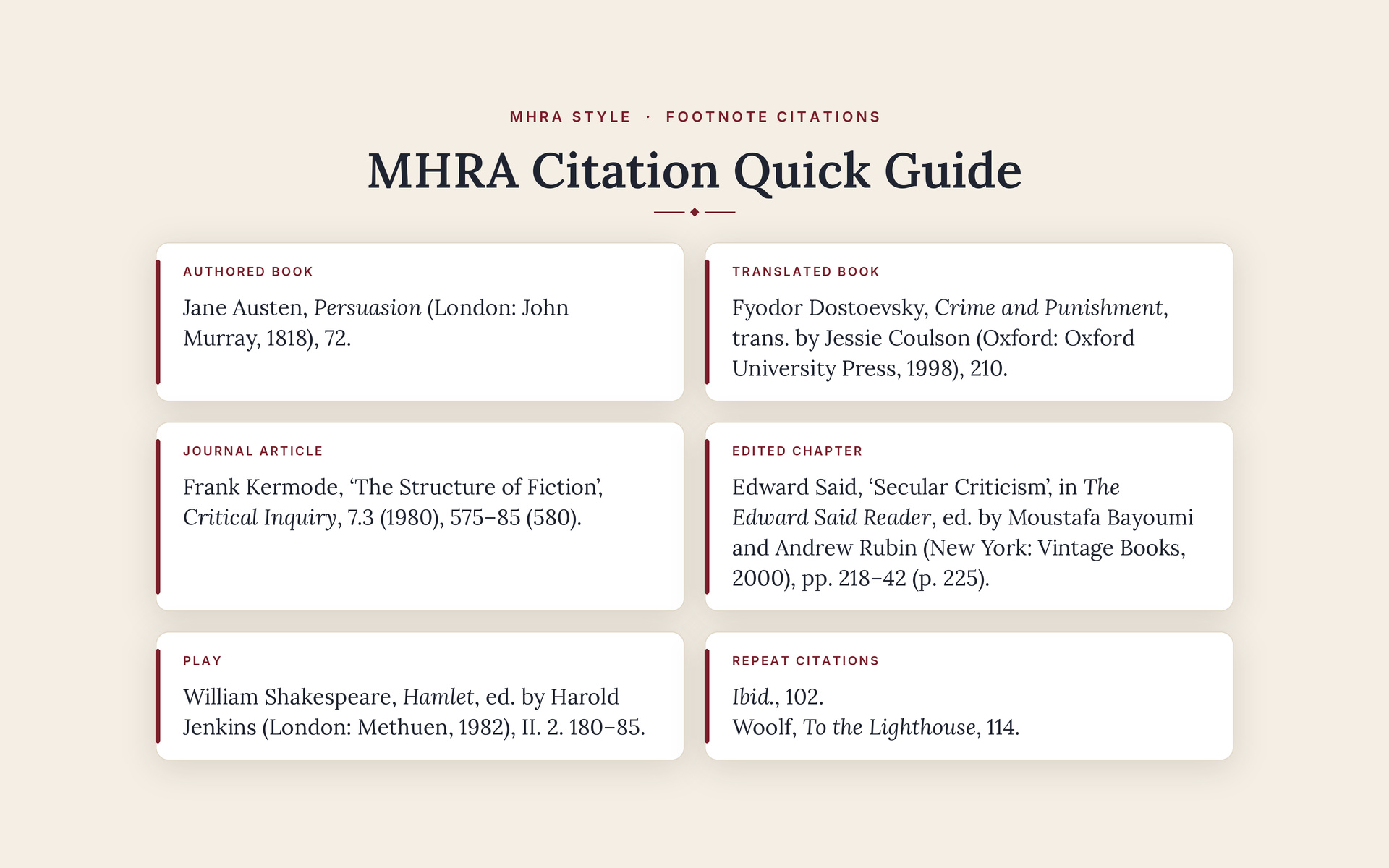
Summary Table: Quick-Reference MHRA Citation Guide
Source Type | Citation Examples |
Authored Book | Footnote: Jane Austen, Persuasion (London: John Murray, 1818), 72. Bibliography: Austen, Jane, Persuasion (London: John Murray, 1818) |
Translated / Edited Book | Footnote: Fyodor Dostoevsky, Crime and Punishment, trans. by Jessie Coulson (Oxford: Oxford University Press, 1998), 210. Bibliography: Dostoevsky, Fyodor, Crime and Punishment, trans. by Jessie Coulson (Oxford: Oxford University Press, 1998) |
Multi-Volume Work | Footnote: Samuel Richardson, Clarissa, 8 vols (London: S. Richardson, 1748), III, 142. Bibliography: Richardson, Samuel, Clarissa, 8 vols (London: S. Richardson, 1748) |
Play / Drama | Footnote: William Shakespeare, Hamlet, ed. by Harold Jenkins (London: Methuen, 1982), II. 2. 180–85. Bibliography: Shakespeare, William, Hamlet, ed. by Harold Jenkins (London: Methuen, 1982) |
Poetry | Footnote: John Milton, Paradise Lost, ed. by Alastair Fowler (London: Longman, 1998), Book IX, lines 425–30. Bibliography: Milton, John, Paradise Lost, ed. by Alastair Fowler (London: Longman, 1998) |
Journal Article | Footnote: Frank Kermode, 'The Structure of Fiction', Critical Inquiry, 7.3 (1980), 575–85 (580). Bibliography: Kermode, Frank, 'The Structure of Fiction', Critical Inquiry, 7.3 (1980), 575–85 |
Edited Book Chapter | Footnote: Edward Said, 'Secular Criticism', in The Edward Said Reader, ed. by Moustafa Bayoumi and Andrew Rubin (New York: Vintage Books, 2000), pp. 218–42 (p. 225). Bibliography: Said, Edward, 'Secular Criticism', in The Edward Said Reader, ed. by Moustafa Bayoumi and Andrew Rubin (New York: Vintage Books, 2000), pp. 218–42 |
Website / Webpage | Footnote: British Library, 'Discovering Literature: Romantics and Victorians', British Library Online, 2014 https://www.bl.uk/romantics-and-victorians [accessed 12 October 2026]. Bibliography: British Library, 'Discovering Literature: Romantics and Victorians', British Library Online, 2014 https://www.bl.uk/romantics-and-victorians [accessed 12 October 2026] |
Archival Document | Footnote: Percy Bysshe Shelley, 'Draft of Ode to the West Wind', Oxford, Bodleian Library, MS Shelley adds. e. 12, fol. 60v. Bibliography: Shelley, Percy Bysshe, 'Draft of Ode to the West Wind', Oxford, Bodleian Library, MS Shelley adds. e. 12 |
Need Help Formatting Your Manuscript to MHRA Standards?
Navigating complex citation rules, footnotes, and bibliographic entries can be time-consuming when preparing a thesis, journal submission, or academic monograph.
If you want to ensure your work meets flawless institutional and publisher guidelines, explore our specialized proofreading and editing services. From verifying citation accuracy to refining academic tone, we help turn your research into a publication-ready manuscript!