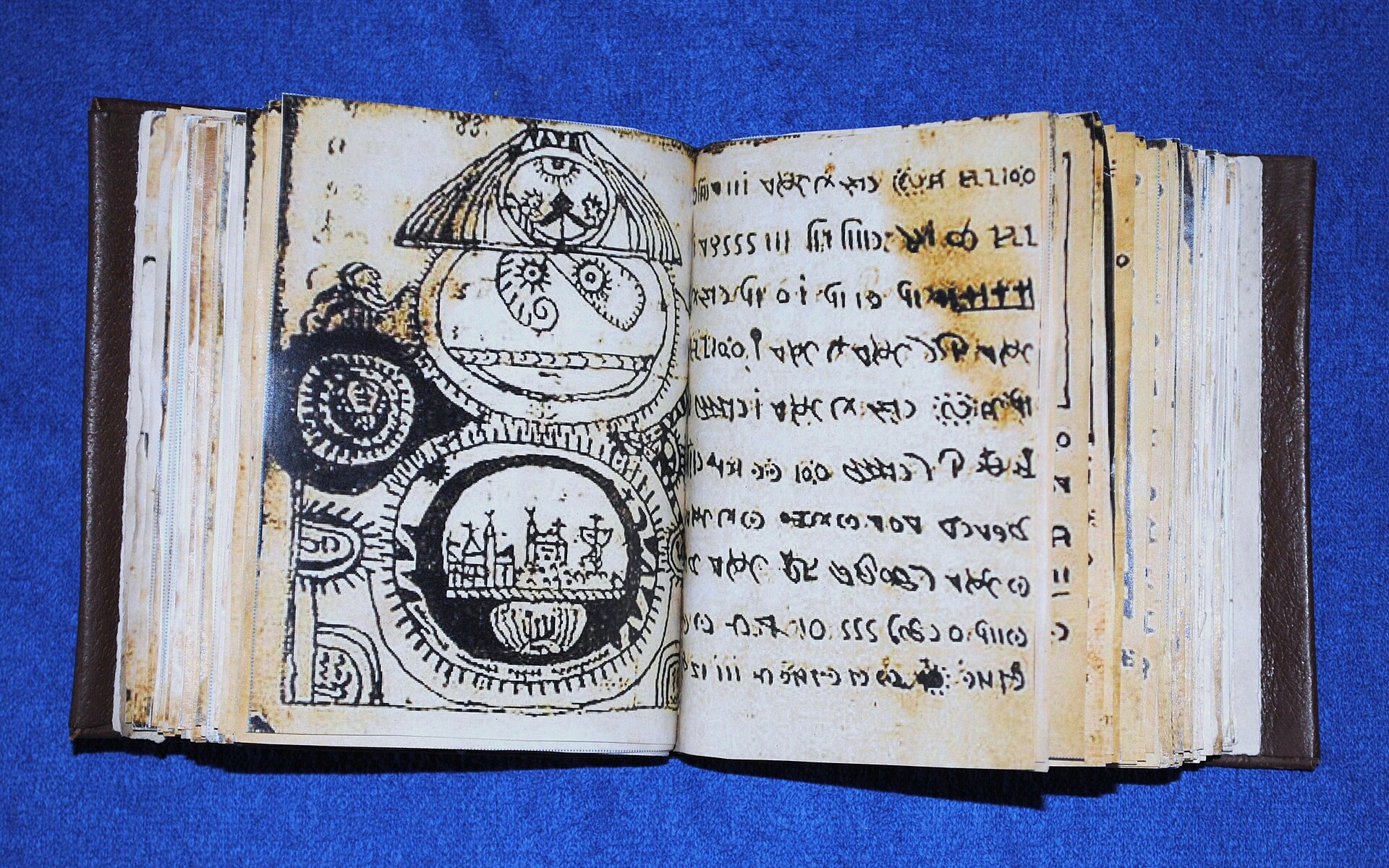
In 1838, Count Gustáv Batthyány donated his entire private collection of over 30,000 books to the Hungarian Academy of Sciences. Tucked among the priceless volumes was a small, unassuming bound manuscript that nobody had ever seen before.
It contained 448 pages of meticulous handwriting in an unknown alphabet, accompanied by hundreds of unusual illustrations.
Nearly two centuries later, the Rohonc Codex remains one of the world's most atmospheric cryptographic enigmas. While the Voynich Manuscript attracts global fame, the Rohonc Codex is its darker, more elusive sibling—a book that has spent centuries baffling historians, linguists, and modern artificial intelligence.
1. A Statistical Nightmare: The Script That Defies Logic
Most natural languages written in an alphabet use between 20 and 40 distinct characters. Logographic languages, like Chinese, use thousands.
The Rohonc Codex sits in a statistical dead zone that makes cryptographers shudder: it uses roughly 200 distinct symbols.
Too many characters for a standard alphabet or syllabary.
Too few characters for a true logographic writing system.
Written right-to-left, though the margins shift without warning from page to page.
Every single symbol is drawn with remarkable precision across all 448 pages. While expert eyes can spot the occasional subtle correction, whoever wrote it moved the pen with the effortless confidence of a master scribe, filling page after page without hesitation.
2. Crosses, Crescents, and Warring Empires
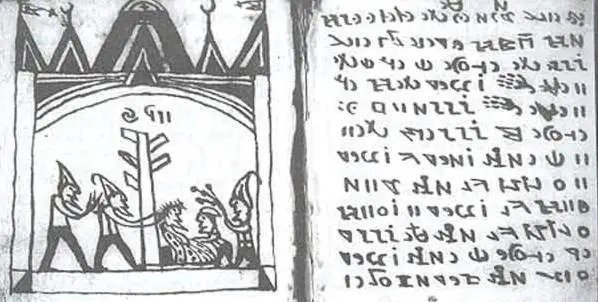
The illustrations within the Rohonc Codex are just as perplexing as its text. Spread across its pages are 87 drawings depicting military battles, landscapes, and vivid religious scenes.
What makes these drawings so surreal is the bizarre mix of symbols:
Christian crosses, Islamic crescents, and pagan sun disks appear side-by-side within the exact same scenes.
Opposing armies bear flags marked with symbols of competing faiths, while buildings display both emblems on their walls.
Different places of worship and religious symbols—from traditional churches to stylized eastern-influenced structures—all sit side-by-side within the same city walls.
Early scholars wondered if the manuscript belonged to a secret heresy—a forgotten cult trying to blend world religions into one. But modern art historians see something far more grounded in real-world drama: a surreal, coded depiction of the brutal 16th-century clash between Christian Europe and the expanding Ottoman Empire, captured by someone living on the chaotic frontier where two civilizations collided.
3. Hoax or Genuine Artifact? The Paper Trail
For decades, skeptics wrote the manuscript off as a 19th-century forgery. The main suspect was Sámuel Literáti Nemes, a notorious Hungarian antiquarian known for faking historical documents.
However, physical analysis of the book completely changed that story:
16th-century paper: Watermark analysis proved the paper was manufactured in Northern Italy—likely Venice—between 1520 and 1540.
Too complex for a hoax: While Nemes was known to collect blank Renaissance paper, creating 448 pages of dense, consistent code would require an unrealistic amount of effort for a simple forgery.
Today, scholars agree the codex is a genuine Renaissance artifact—produced during an era marked by deep religious turmoil and conflict.
4. A Crack in the Cipher: The Major Breakthrough
For generations, computational linguists and neural networks hit a brick wall trying to break the text. Theories ranged from a dead Transylvanian dialect to an early constructed language (conlang) built for esoteric rituals.
Then came a quiet revolution in cryptanalysis.
Between 2009 and 2018, Hungarian researchers Levente Zoltán Király and Gábor Tokai achieved what seemed impossible. By running deep structural and frequency analyses on the 200-symbol system, they proved the codex wasn't a hoax or a lost ancient tongue—it was an intricate, encrypted Christian prayer book.
They managed to decode key biblical names like Jesus and Mary, pinpoint religious feast days, and match sentence patterns directly to the Gospels. While Király and Tokai decoded how the system actually works, reading the entire manuscript cover-to-cover is still a work in progress. Even so, their breakthrough is the closest anyone has ever come to unraveling the book.
5. The Strange World Inside the Drawings: What Do They Reveal?
While the code took nearly two centuries to untangle, the 87 illustrations offer a fascinating look into the author's world:
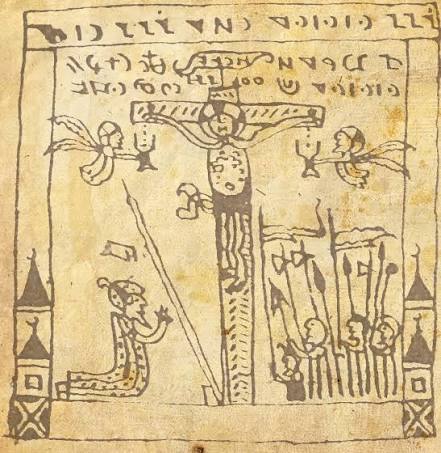
Biblical scenes with hidden labels: Full-page drawings show scenes like the Nativity, the Crucifixion, and Jesus entering Jerusalem, all surrounded by encrypted text that Király and Tokai matched to biblical figures.
A war of symbols: Battle scenes depict the ongoing clash between Christian and Ottoman forces and capture the deep tension of 16th-century Europe.
Blended architecture: Background buildings mix Western Gothic elements with unusual Eastern-style domes and towers, reflecting the atmosphere of border towns along the Ottoman frontier.
Celestial wheels: Scattered throughout the book are detailed astronomical charts used to track religious feast dates and cosmic patterns.
6. Micro-Details: Hidden Oddities in the Margins
Beyond the main illustrations, the manuscript is packed with subtle, intriguing details:
Continuous script: The text runs continuously across pages without standard punctuation or clear sentence breaks, which made early software decoding extremely difficult.
Margin miniatures: Border spaces contain tiny human figures and minor symbol variations that likely served as visual markers or reference guides for reading the cipher.
Formal gestures: Figures throughout the drawings display stiff, specific hand positions—a common feature in Renaissance art where hand gestures were used to convey precise religious meanings.
7. The Obsession of a Master: A Legacy Encrypted in Ink
Creating a 448-page manuscript by hand required immense effort, rare materials, and years of devotion.
Why go to such extreme lengths to hide a Christian prayer book? In an era marked by aggressive Ottoman expansion, violent Protestant-Catholic conflicts, and shifting political loyalties, encoding a sacred book wasn't just an intellectual puzzle. It was a way to survive—or perhaps the quiet, intensely personal devotion of a scribe surrounded by the chaos of a changing world. Whoever wrote the Rohonc Codex spent a lifetime embedding their faith into an unbreakable vault of ink and symbols.
The Verdict: A Secret Kept for Five Centuries
The Rohonc Codex is no longer an absolute mystery, but its magic hasn't faded. It stands today as one of the most remarkable cryptographic achievements of the Renaissance—a breathtaking bridge between secret traditions, personal devotion, and the turbulent history of 16th-century Europe.