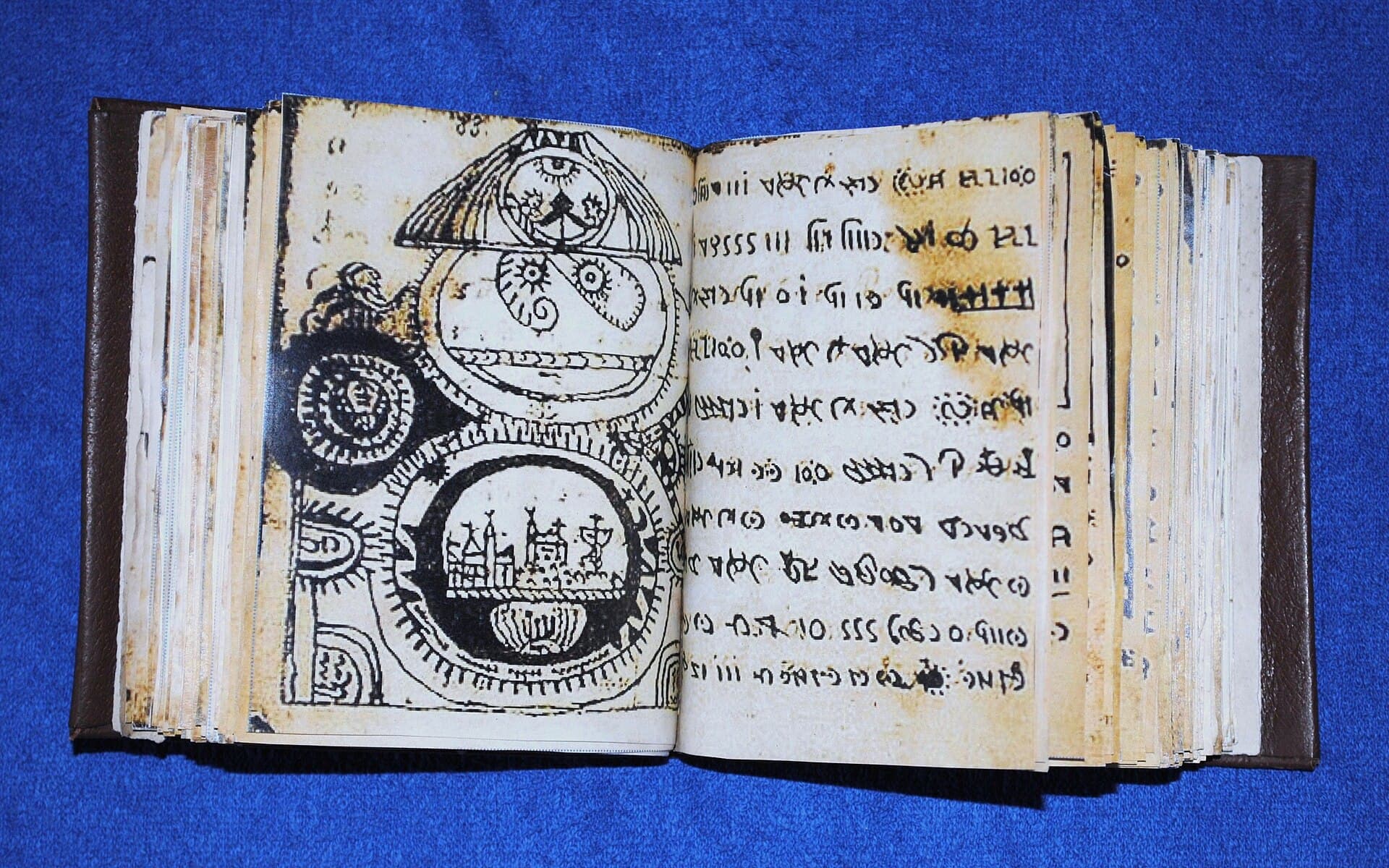
In the autumn of 1912, a quiet, sharp-eyed rare book dealer named Wilfrid Voynich traveled to the Villa Mondragone—a breathtaking Jesuit college tucked away in the hills near Rome. The Jesuits, facing financial trouble, had decided to quietly liquidate a chest of ancient manuscripts that had sat undisturbed in their private library for centuries.
As Voynich sifted through dusty parchment and medieval bindings, one volume immediately caught his eye. It was small, bound in plain, unpretentious vellum, and completely unlike anything he had ever seen.
When modern radiocarbon testing was finally performed on the parchment in the early 2000s, scientists confirmed that the animal skins were prepared between 1404 and 1438—right at the dawn of the Italian Renaissance. Yet, more than six hundred years after its creation, the manuscript remains as silent and unreadable as the day Voynich pulled it from that wooden chest.
Inside a Medieval Mind-Bend
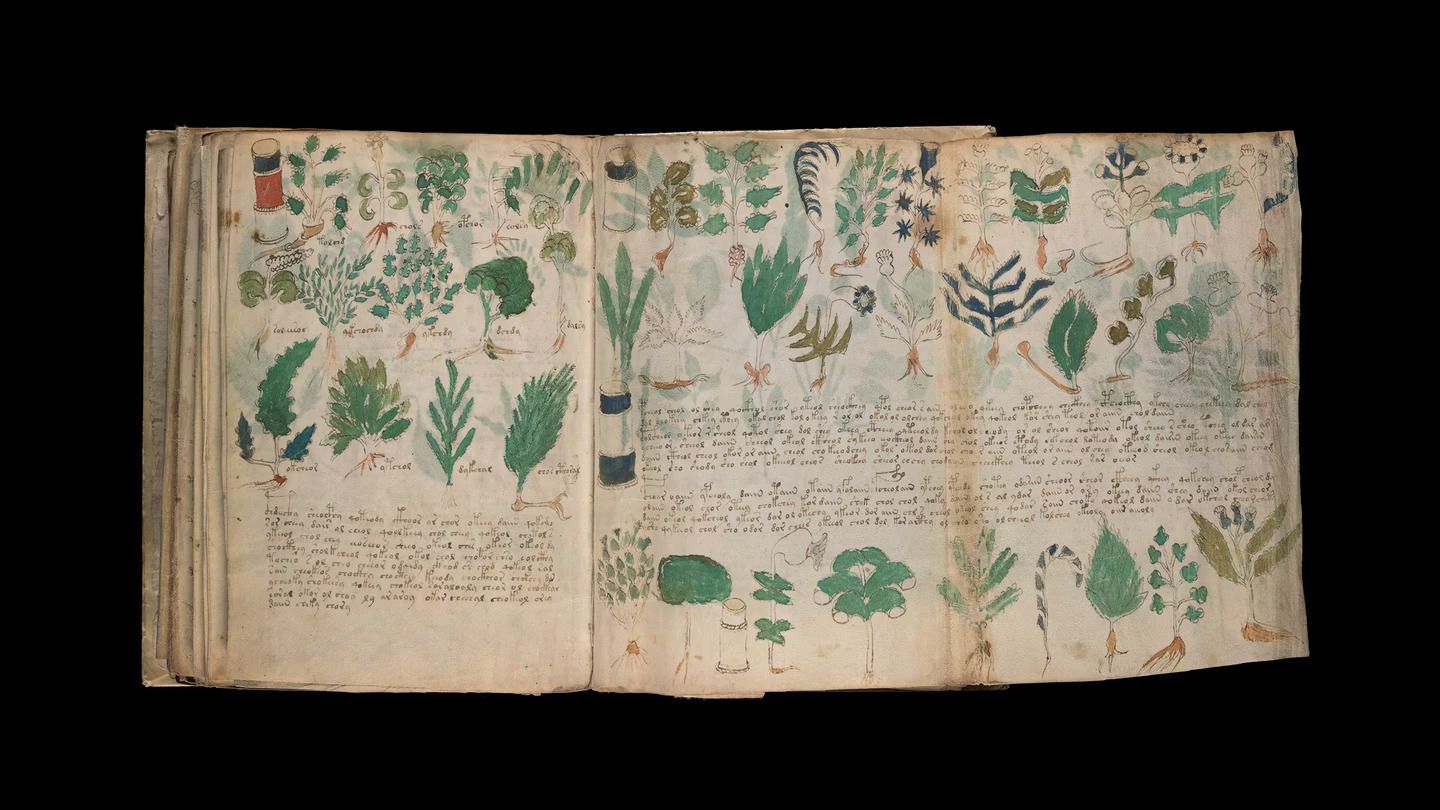
The book spans roughly 240 pages, and nearly every leaf is covered in hand-drawn, watercolor illustrations broadly split into six surreal sections:
The botanical section: Dozens of pages depicting plants that do not exist anywhere in nature, featuring composite roots from one species, stems from another, and strange leaves that seem almost engineered.
The astronomical & astrological section: Circular diagrams and zodiac wheels filled with suns, moons, and constellations that match no known sky map.
The balneological (biological) section: Perhaps the most bizarre part of the book, featuring miniature naked women bathing in interconnected, pipe-like systems filled with a dark green fluid.
The cosmological & pharmaceutical sections: Dozens of intricate diagrams resembling medieval maps, followed by pages of small jars, roots, and leaves—likely intended as a handbook for medicine or alchemy.
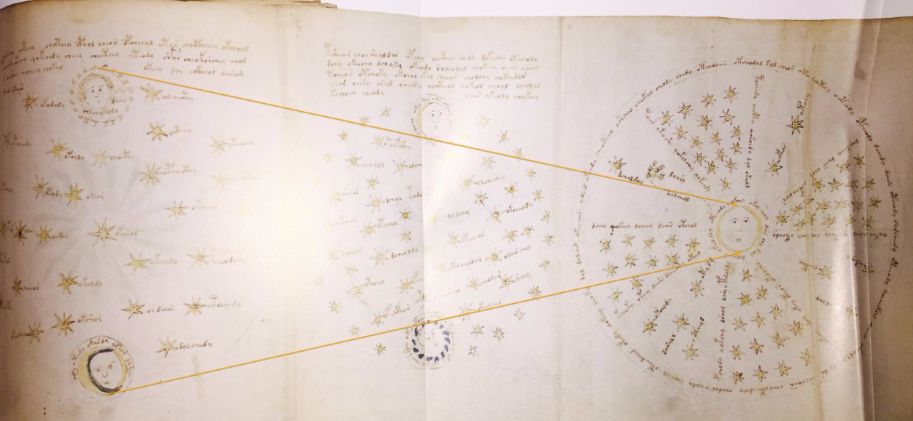 𝘝𝘰𝘺𝘯𝘪𝘤𝘩 𝘔𝘢𝘯𝘶𝘴𝘤𝘳𝘪𝘱𝘵 𝘢𝘴𝘵𝘳𝘰𝘯𝘰𝘮𝘪𝘤𝘢𝘭 𝘥𝘪𝘢𝘨𝘳𝘢𝘮
Surrounding these drawings is a smooth, fluid script written left-to-right with no strikethroughs, no corrections in the margins, and no signs of hesitation across all 240 pages. In medieval manuscripts, scribes constantly made mistakes and scraped the vellum clean—yet here, the writing flows as if the author were writing in a fluent native language without a moment's doubt.
The alphabet consists of roughly 20 to 30 unique symbols, now called "Voynichise." Linguists have shown that this isn't just gibberish. The text follows Zipf’s law—a mathematical pattern found in every real human language—and uses repeating prefixes and suffixes just like normal speech. Somebody spent thousands of painstaking hours writing a structured, rule-bound text that no human alive can read.
A 600-Year Trail of Imperial Gold and Dark Alchemy
The true magic of the manuscript lies in its dark, sprawling history—a trail filled with Siberian escapes, earless alchemists, and imperial fortunes.
Even Wilfrid Voynich, the man who brought the book into the modern world, lived a life straight out of an adventure novel. Before becoming a rare book dealer in London, Voynich was a Polish revolutionary. Arrested by the Russian tsarist police and locked in a fortress, he was exiled to a forced labor camp in Siberia. He managed a daring escape across China and North America, eventually arriving in Europe to trade in secret manuscripts. When he pulled the vellum book from that Jesuit chest in 1912, he immediately recognized that he was holding a dangerous piece of history.
In the late 16th century, the manuscript surfaced in Prague at the court of Holy Roman Emperor Rudolph II—one of the most eccentric monarchs in European history, who neglected his political duties to fill his castle with alchemists and astrologers. According to a 17th-century letter found with the manuscript, an unknown buyer—long believed by scholars to be Rudolph himself—paid an astonishing 600 gold ducats for the book, believing it to be the secret lost work of 13th-century Franciscan friar Roger Bacon.
During this exact period in Prague, the book intersected with Dr. John Dee, mathematician, cryptographer, and official astrologer to Queen Elizabeth I. Some historians speculate that Rudolph was completely conned by Dee’s associate, Edward Kelley. Kelley was a notorious alchemist who had his ears cropped off in England for forging coins—a secret he hid under a heavy velvet cap. Kelley claimed he could turn base metals into gold and speak to angels through crystal spheres. Knowing the emperor’s obsession with the occult, Kelley may have spent months fabricating the unreadable script specifically to trick Rudolph out of his gold reserves.
By 1665, the manuscript was sent to Rome to Athanasius Kircher, a famous German Jesuit polymath who claimed he could decode Egyptian hieroglyphs. Johannes Marcus Marci, the royal physician in Prague, tucked a letter inside the front cover—dated August 19, 1665 or 1666—asking Kircher to solve the puzzle. Kircher studied the pages for years, grew thoroughly stumped, and stashed the volume deep inside a library vault. There it slept for 247 years until Voynich uncovered it.
Hidden Erasures and Fold-Out Maps
If you open the manuscript, the artifact itself holds clues that read like a detective story:
The erased signature: Decades ago, scientists used ultraviolet light on the first page. Under the invisible rays, erased writing appeared at the bottom: Jacobj à Tepenece. This was the signature of Jacobus Sinapius, Emperor Rudolph’s personal physician who made a fortune selling a famous herbal elixir. His erased name proves the manuscript passed through Rudolph’s inner circle.
The six-page fold-out: Several pages unfold into massive diagrams, including a famous six-page fold-out showing nine interconnected "rosettes" that resemble volcanoes, medieval towers, and microscopic structures.
German marginalia: On folio 116v, written in a standard medieval hand, appear the words so nymm—an early German phrase meaning "so take...", the universal opening for medieval medical recipes.
Missing pages: Page numbers added later show that at least 28 pages are completely missing. Someone carefully cut out entire sections centuries ago—perhaps removing the very key to the cipher.
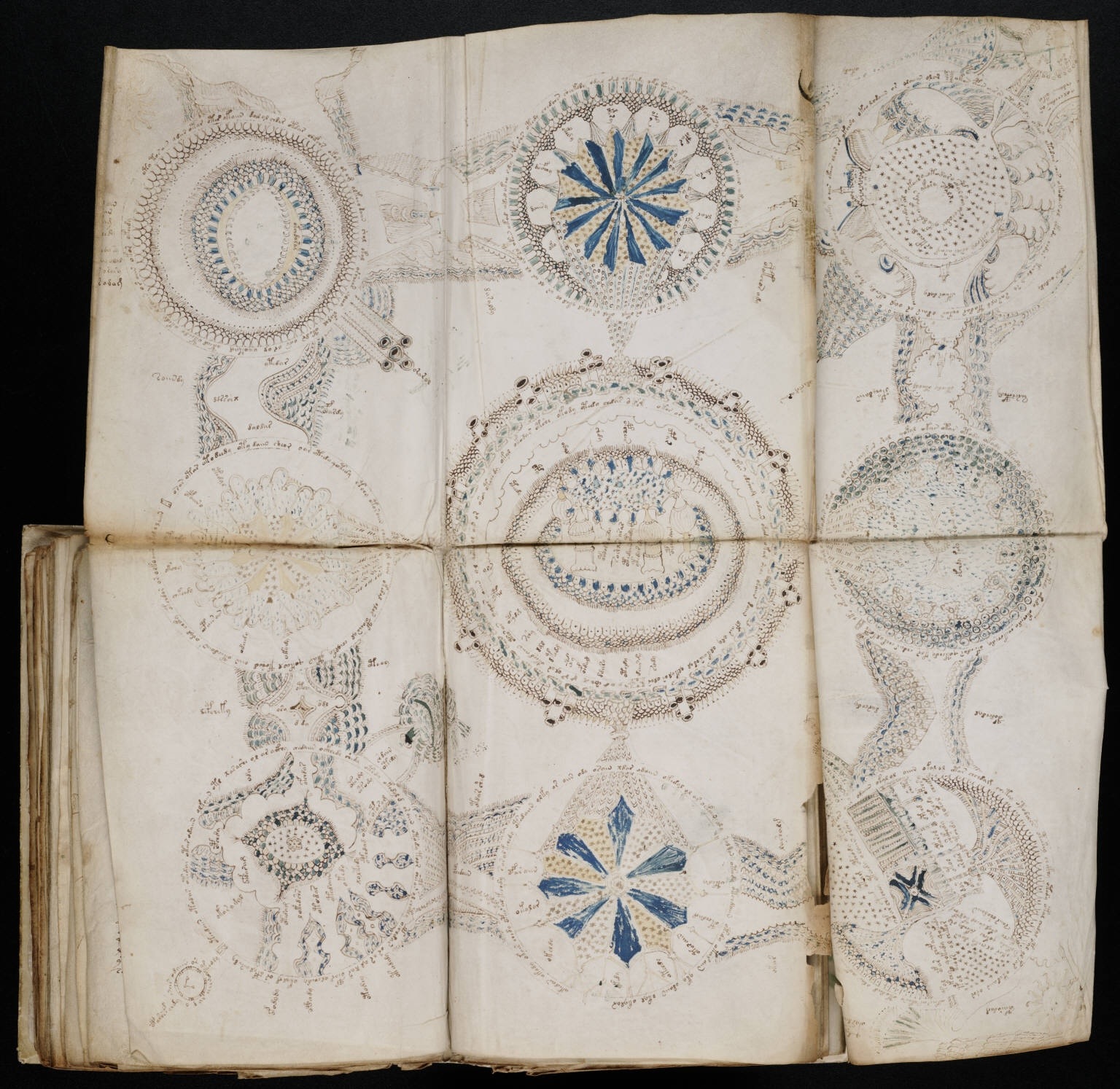 𝘝𝘰𝘺𝘯𝘪𝘤𝘩 𝘔𝘢𝘯𝘶𝘴𝘤𝘳𝘪𝘱𝘵 𝘳𝘰𝘴𝘦𝘵𝘵𝘦𝘴 𝘧𝘰𝘭𝘥𝘰𝘶𝘵
Codebreakers, Cold War Spies, and Artificial Intelligence
If Renaissance minds failed because they lacked modern tools, the 20th century proved technology wasn't the magic key either:
Cracking Enigma wasn't enough: During and immediately following WWII, William F. Friedman—the legendary American cryptanalyst who broke the Japanese PURPLE cipher—assembled an off-duty team of codebreakers who applied punch-card data processing, frequency analysis, and statistical methods to the Voynich Manuscript, only to walk away empty-handed.
The Cold War theories: Scholars spent decades testing wild theories. Was it an encrypted dialect of early Ukrainian? A medieval shorthand system? An elaborate hoax? Carbon dating eventually proved the vellum was genuinely medieval, yet it couldn't rule out a medieval hoax—and the text remained a total mystery.
The AI collapse: In 2018, computer scientists trained advanced natural language processing models to analyze character patterns. The AI proudly announced the text was likely encrypted ancient Hebrew. However, when historical linguists examined the actual sentence outputs, they were nonsensical, broken fragments that made zero grammatical sense.
Today, the original manuscript sits in a climate-controlled vault at Yale University’s Beinecke Library under catalog number MS 408, remaining history’s ultimate unsolved academic enigma.
The Lesson Hiding in Plain Sight
Six hundred years ago, an author spent thousands of hours writing down knowledge that no human being could ever read. Today, that parchment sits behind bulletproof glass in a quiet library vault—a masterpiece of wasted brilliance.
For modern researchers, the Voynich Manuscript is a stark reminder: brilliance means nothing if the message stays locked inside. When findings are buried beneath dense phrasing and obscure structure, even revolutionary work gets set aside. True discoveries don't belong in locked vaults—they belong in print, read and cited by the world.