Whether you are writing a college literature essay, a high school research paper, or an academic blog post, getting your citations right is non-negotiable. Proper citation gives credit to original creators, boosts your credibility, and protects you from accidental plagiarism.
The Modern Language Association (MLA) updated its guidelines with the 9th Edition, making citation more standardized, flexible, and digital-friendly.
This step-by-step guide breaks down everything you need to know about MLA 9th Edition—from document formatting and in-text citations to building a flawless Works Cited page.
1. Document Setup & Page Formatting
Before you type a single word, set up your word processor (Google Docs, Microsoft Word, or Apple Pages) with these standard rules:
Margins: 1 inch (2.54 cm) on all four sides (top, bottom, left, right).
Font: Standard, highly legible font where normal and italic text are easily distinguishable (such as Times New Roman, Arial, or Calibri) at 12 pt size.
Spacing: Double-spaced throughout the entire document, including block quotes and the Works Cited page. Do not add extra blank lines between paragraphs.
Indentation: Indent the first line of every body paragraph by 0.5 inches (press the Tab key once).
Alignment: Left-aligned text (do not use full justification, as it creates uneven spacing between words).
The First Page Header
MLA does not require a separate cover or title page unless your instructor explicitly asks for one.
In the top-left corner of the first page, place your primary heading (double-spaced, flush left):
Your Full Name
Instructor's Name
Course Name and Number
Submission Date (formatted as day–month–year, e.g., 15 November 2026)
On the very next line, center your paper's title. Do not bold, underline, or place quotation marks around your main title (unless the title itself contains the name of another work).
Running Head (Page Numbers)
In the top-right header of every single page (0.5 inches from the top edge, right-aligned), include your last name followed by the page number (e.g., Smith 1).
2. In-Text Citations (Author-Page System)
MLA uses an author-page system for in-text parenthetical citations. This briefly points the reader to the corresponding full entry on your Works Cited page.
Basic In-Text Citation
Place the author's last name and the exact page number in parentheses at the end of the sentence, right before the period.
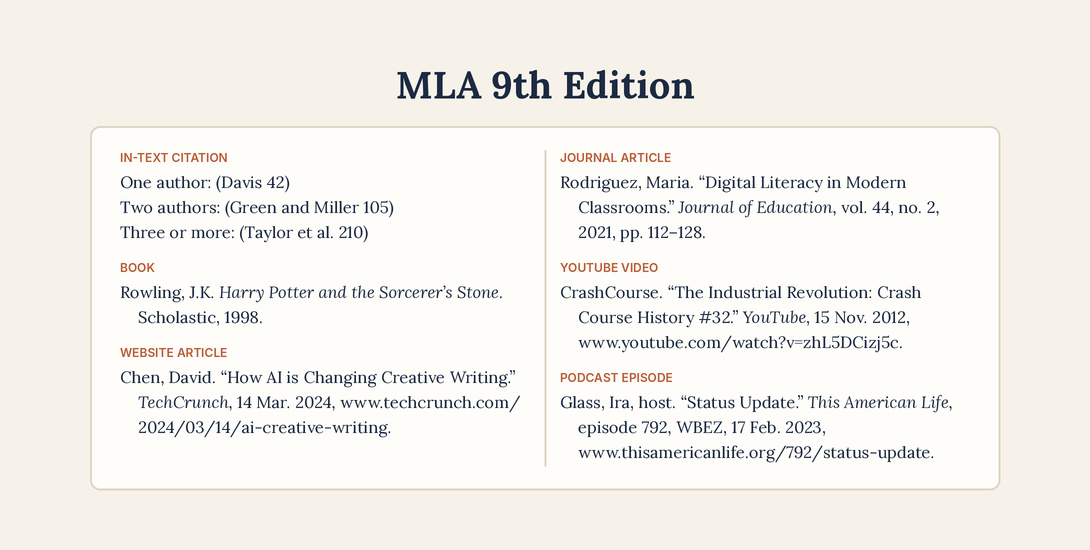
Parenthetical citation: Reading complex literature builds empathy across diverse cultures (Davis 42).
Signal phrase (narrative citation): If you mention the author's name directly in the sentence, only include the page number in parentheses: According to Davis, reading complex literature builds empathy across diverse cultures (42).
Variations & Edge Cases
Two authors: Connect both surnames using the word "and" (Green and Miller 105).
Three or more authors: List the lead author's surname followed by "et al." (Taylor et al. 210).
No author: Use a shortened version of the title. Place article titles in quotation marks ("Global Warming Impact" 12) and book titles in italics (Modern Poetry 88).
Corporate author or organization: Cite the full name of the organization or agency (World Health Organization 14).
Online sources without page numbers: Omit the page number entirely (Morrison), or use fixed locators such as paragraph numbers (Smith, par. 4) or timestamps (Smith 00:14:20).
3. Block Quotes (Long Direct Quotations)
If a direct quotation extends longer than 4 lines of text in your paper (or more than 3 lines of poetry), you must format it as a block quote:
Start the quotation on a brand new line.
Indent the entire block 0.5 inches from the left margin.
Maintain double spacing throughout the quote.
Do not place quotation marks around the block quote.
Place the period at the end of the quote BEFORE the parenthetical citation (this is unique to block quotes in MLA).
Correct: ... emotional evolution. (Harrison 88)
Incorrect: ... emotional evolution (Harrison 88).
4. The Works Cited Page
The Works Cited page appears at the very end of your paper on a fresh page. It lists every single source you cited in your text.
Layout Rules:
Page title: Center the words "Works Cited" at the top of the page (no bold, italics, or quotation marks).
Alphabetical order: Sort all entries alphabetically by the author's last name. If an entry has no author, alphabetize it by the first principal word of the title.
Hanging indent: The first line of each entry is flush left, while any subsequent lines of that same entry are indented by 0.5 inches.
URLs: Include full URLs (you may omit http:// or https:// if desired, but keep www.). Never use shortened links like bit.ly.
5. The Container System (The 9 Core Elements)
The biggest advantage of MLA 9th Edition is that you no longer need to memorize hundreds of different rules for every single type of source. Instead, every citation is built like a puzzle using a single universal template.
Think of it as filling in up to 9 blanks (core elements) in this exact order, using standard punctuation:
Author. (Who created it? Ends with a period.)
Title of source. (What is it called? Ends with a period.)
Title of container, (Where is it housed? Ends with a comma.)
Contributor, (Was there an editor, translator, or narrator? Ends with a comma.)
Version, (Is it a specific edition, director's cut, or version? Ends with a comma.)
Number, (Is it a volume, issue, or season/episode number? Ends with a comma.)
Publisher, (Who published or produced it? Ends with a comma.)
Publication date, (When was it released? Ends with a comma.)
Location. (What is the page range, URL, or physical place? Ends with a period.)
A container is simply the larger "home," platform, or host that holds your source. If your source is a small piece of a bigger puzzle, that bigger puzzle is the container.
Here are a few quick, everyday examples of containers:
A book chapter is inside an anthology or book (the book is the container).
A journal article is inside a scholarly journal (the journal is the container).
A blog post or news article is inside a website (the website is the container).
A TV show episode is inside a streaming service or series (Netflix or the TV series is the container).
Rule of thumb: If an element doesn't apply to your source (for example, if a website article doesn't have a version or a contributor), you simply skip it and move on to the next one!
6. Real-World Citation Examples
1. Print Book (Single Author)
Template: Author Last Name, First Name. Book Title. Publisher, Year.
Example: Rowling, J.K. Harry Potter and the Sorcerer's Stone. Scholastic, 1998.
2. Scholarly Journal Article (From an Online Database)
Template: Author Last Name, First Name. "Article Title." Journal Name, vol. Volume, no. Issue, Year, pp. Page range. Database Name, DOI or URL.
Example: Rodriguez, Maria. "Digital Literacy in Modern Classrooms." Journal of Education, vol. 44, no. 2, 2021, pp. 112–128. JSTOR, doi:10.1080/00221546.2021.123456.
3. Website Article
Template: Author Last Name, First Name. "Article Title." Website Name, Publisher (if different from site name), Date Published, URL. Accessed Day Month Year.
Example: Chen, David. "How AI is Changing Creative Writing." TechCrunch, 14 Mar. 2024, www.techcrunch.com/2024/03/14/ai-creative-writing. Accessed 10 Oct. 2026.
4. YouTube Video
Template: Creator Last Name, First Name or Channel Name. "Video Title." YouTube, uploaded by Channel Name, Date uploaded, URL.
Example: CrashCourse. "The Industrial Revolution: Crash Course History #32." YouTube, 15 Nov. 2012, www.youtube.com/watch?v=zhL5DCizj5c.
5. Podcast Episode
Template: Host Last Name, First Name, host. "Episode Title." Podcast Name, season Number, episode Number, Publisher, Date, URL.
Example: Glass, Ira, host. "Status Update." This American Life, episode 792, WBEZ, 17 Feb. 2023, www.thisamericanlife.org/792/status-update.
The Final Polish: Your Pre-Submission Checklist
Before you hit "Print" or convert your document to a PDF, take a moment to conduct one last thorough review. Running through this essential checklist guarantees that your manuscript is fully compliant with MLA 9th Edition standards:
Verify your margins: Set uniform one-inch (1") margins across all four sides of the document.
Review line spacing: Keep the entire text consistently double-spaced, avoiding artificial extra line breaks between paragraphs.
Inspect the running head: Position your surname and page number neatly in the top-right header of every single page.
Structure the first-page heading: Align your formal four-line heading (name, instructor, course, date) to the top-left margin of page one.
Cross-reference in-text citations: Match every parenthetical reference in your body text directly to a corresponding entry on your bibliography.
Apply hanging indents: Indent subsequent lines of each source listing by precisely half an inch (0.5").
Alphabetize the reference list: Arrange your Works Cited entries in strict alphabetical order by the author's surname (or primary title if no author is listed).
Concluding Insight
Citing sources correctly is less about memorization and more about paying attention to details like punctuation, italics, and containers. Keep the 9 core elements handy, and you will be able to structure any source type smoothly!
Still feeling overwhelmed by hanging indents and citation rules? Don't let strict formatting details slow you down right before your deadline. Calculate your price and let an expert polish your paper today!