In electrical engineering, computer science, robotics, telecommunications, and biomedical technology, precision is everything. The Institute of Electrical and Electronics Engineers (IEEE) style is the undisputed gold standard for technical documentation and academic publishing.
Unlike author-date systems (such as APA or Harvard), IEEE relies on a numerical in-text citation system matched to an ordered reference list at the end of the manuscript. Beyond references, IEEE specifies strict conventions for formatting equations, code snippets, figures, and technical terminology.
This style guide breaks down the essential IEEE formatting standards to ensure your manuscript is clean, polished, and ready for peer review.
Part 1: Core Rules for Numerical Citations
Sequential numbering: Each reference is assigned a unique numeral based on its initial appearance in the text, starting with [1] for the primary cited source.
Re-using numbers: Once a source is assigned a number, reuse that same number whenever you cite it later in the paper.
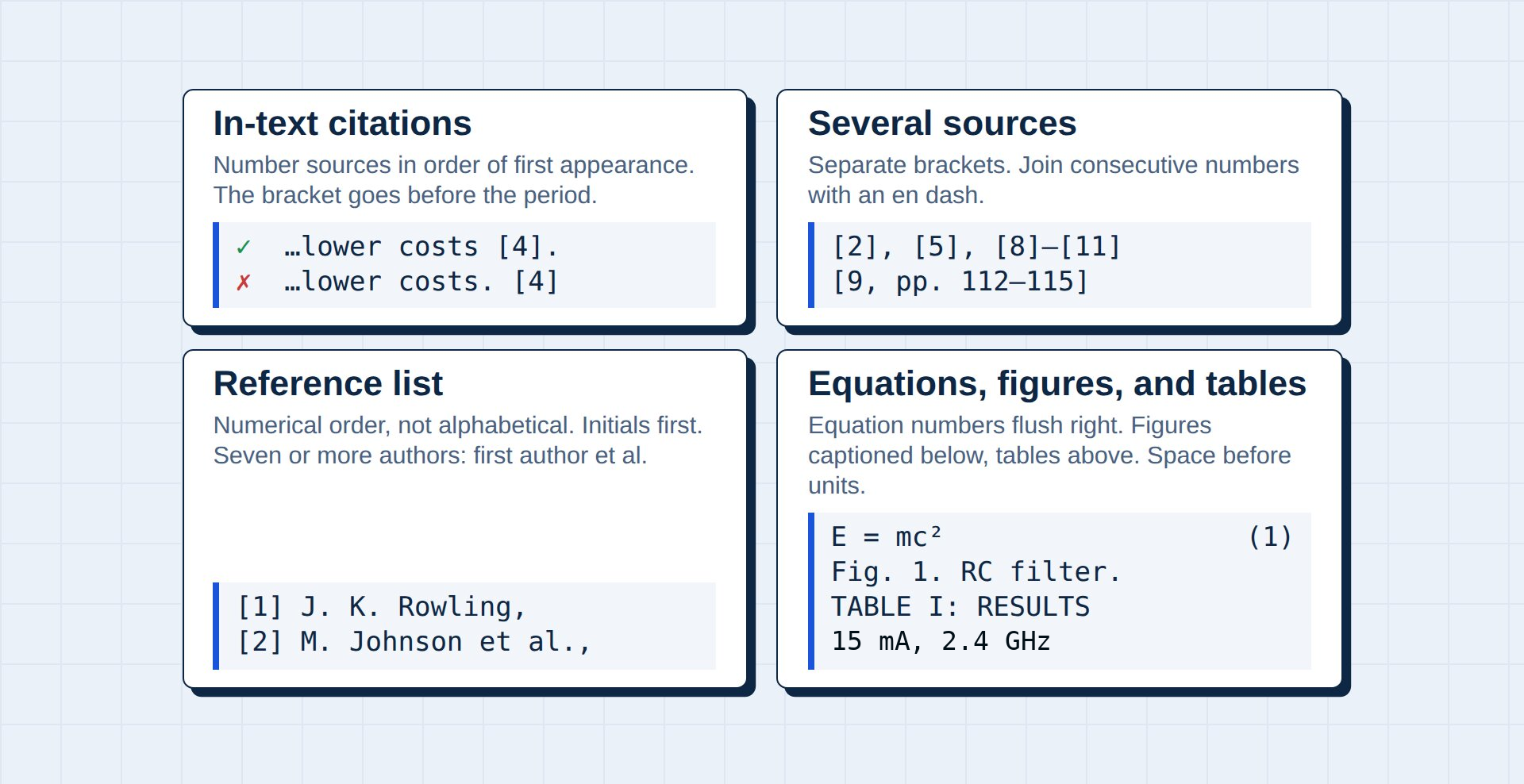
Punctuation placement: The bracketed citation goes inside the sentence's punctuation (before the period, comma, or colon).
Correct: As demonstrated by Chen [3], deep neural networks reduce error rates.
Incorrect: As demonstrated by Chen, [3] deep neural networks reduce error rates.
Grammatical function: IEEE bracketed numbers act as independent nouns or parenthetical markers. You do not need to write "in reference [5]"; you can simply write "in [5]".
In-Text Formatting Examples
Single source:
Recent advancements in microfluidic sensors have significantly lowered manufacturing costs [4].
Mentioning author names:
According to Smith and Zhao [12], low-latency transmission remains a bottleneck. (Note: Do not include publication years or author first names in the text).
Multiple sources (separate brackets):
Several algorithms have been proposed to solve TSP under dynamic constraints [2], [5], [8]–[11]. (Note: Join consecutive numbers with an en dash: [8]–[11], not [8-11]).
Citing specific pages or equations:
The primary optimization equation is defined in [6, eq. (4)] or explained in detail in [9, pp. 112–115].
Part 2: Reference List Core Rules
The reference list appears at the very end of your paper under the unnumbered section heading "References."
General Layout Checklist:
Order: Listed in numerical order ([1], [2], [3]...), NOT alphabetical.
Alignment: Bracketed numbers are flush left. The text of the reference is indented uniformly (hanging indent alignment relative to the bracket width).
Author names: Write the author’s first initial(s) followed by their last name (e.g., J. K. Rowling).
Author count:
1 to 6 authors: List all authors separated by commas.
7 or more authors: List the first author followed by "et al." (e.g., M. Johnson et al.).
Article titles: Enclose in double quotation marks ("...") using title case or sentence case as per target transaction, but keep capitalization consistent.
Journal/conference titles: Italicize full names or standard IEEE abbreviated titles (e.g., IEEE Trans. Autom. Control).
Part 3: Reference List Templates & Examples by Source Type
1. Journal Articles
Template: [#] A. A. Author and B. B. Author, "Title of article," Abbreviated Title of Journal, vol. x, no. x, pp. xxx–xxx, Abbrev. Month, Year, doi: 10.xxx/xxx.
Example: [1] R. K. Gupta, T. Zhang, and H. V. Poor, "Distributed consensus mechanisms for low-latency IoT networks," IEEE Internet Things J., vol. 11, no. 3, pp. 4102–4115, Feb. 2024, doi: 10.1109/JIOT.2023.3298101.
2. Conference Proceedings (Papers from Symposia/Conferences)
Template: [#] A. A. Author, "Title of paper," in Abbrev. Name of Conf., City of Conf., Abbrev. State/Country, Year, pp. xxx–xxx.
Example: [2] S. Patel and M. Al-Mansoor, "Edge computing optimization using reinforcement learning," in Proc. IEEE Int. Conf. Robot. Autom. (ICRA), London, U.K., 2023, pp. 1845–1851.
3. Books and Handbooks
Template: [#] A. A. Author, Title of Book, xth ed. City of Publisher, Abbrev. State, Country: Publisher, Year.
Example: [3] D. A. Patterson and J. L. Hennessy, Computer Architecture: A Quantitative Approach, 6th ed. Cambridge, MA, USA: Morgan Kaufmann, 2019.
4. Standards and Patents
Template (standard): [#] Title of Standard, Standard Number, Corporate Author, City, Country, Year.
Example (standard): [4] IEEE Standard for Information Technology—Telecommunications and Information Exchange Between Systems, IEEE Standard 802.11-2020, IEEE, Piscataway, NJ, USA, 2020.
Template (patent): [#] A. A. Author, "Title of patent," U.S. Patent x xxx xxx, Abbrev. Month, Day, Year.
Example (patent): [5] K. Takahashi, "High-efficiency photovoltaic cell architecture," U.S. Patent 10 982 114, Apr. 20, 2021.
5. Online Datasets, Code Repositories, and Technical Reports
Template (dataset): [#] A. A. Author, "Title of dataset," Repository Name, Year. doi: 10.xxxx/xxxx.
Example (dataset): [6] A. Davis and M. Smith, "Global solar irradiance dataset 2020–2024," Zenodo, 2024. doi: 10.5281/zenodo.1234567.
Template (code repository): [#] A. A. Author, "Title of repository," Platform, Year. [Online]. Available: URL
Example (GitHub): [7] A. M. Turing, "Benchmark datasets for quantum circuit emulation," GitHub, 2025. [Online]. Available: https://github.com/google/qsim
Template (technical report): [#] Corporate Author, "Title of report," Organization, City, State/Country, Tech. Rep. [Number], Month Year.
Example (technical report): [8] National Renewable Energy Laboratory, "2025 Grid Integration Assessment," NREL, Golden, CO, USA, Tech. Rep. NREL/TP-5500-81200, Nov. 2025.
Part 4: Technical Formatting Rules
References are only half the battle. Keep these core rules in mind for equations, units, figures, and tables:
1. Equations and Formulas
Center displayed equations on a new line.
Number equations sequentially with Arabic numerals in parentheses flush right: (1), (2).
Reference equations in the text as (1) or Equation (1) (use Equation only at the start of a sentence).
f(x) = ∫ e^(-λt) x(t) dt (1)
In-text: Substituting (1) into the state-space formulation yields...
2. Units and Numbers
Always insert a space between a number and its unit: 15 mA, 2.4 GHz, 500 kV.
Use standard SI symbols rather than spelling out units: 5 km, 8 GB, 30 W, 10 ms.
Express ranges with an en dash or explicitly: 10–20 MHz or from 10 MHz to 20 MHz.
3. Figures and Tables
Figures: Position captions beneath the image (e.g., "Fig. 1. Circuit schematic of the low-pass filter."), using the abbreviation "Fig." in captions and within sentences (e.g., "as shown in Fig. 1..."), while writing "Figure" in full when starting a sentence.
Tables: Position titles above the table using Roman numerals and small caps (e.g., "TABLE I: PERFORMANCE COMPARISON OF ALGORITHMS"), keeping "Table" fully spelled out in all in-text references.
IEEE Reference Summary
Source Type | Title Formatting | What to Include in Reference |
Journal Article | In quotation marks ("...") | Abbreviated journal name (italicized), volume, issue, page range, month/year, and DOI |
Conference Paper | In quotation marks ("...") | Abbreviated conference name (e.g., Proc...), location, year, and page range |
Book | Italicized (for book chapters: "...") | Edition, publisher name, publication location, and year |
Patent | In quotation marks ("...") | Patent number, issuing country/organization, and year |
Standard | Italicized | Standard number, issuing organization, and year of release |
Online Dataset | In quotation marks ("...") | Repository name, year, and DOI |
Code Repository | In quotation marks ("...") | Platform name (e.g., GitHub), year, followed by [Online]. Available: URL |
Technical Report | In quotation marks ("...") | Organization, location, Tech. Rep. number, and month/year |
Ensure Flawless IEEE Formatting
Formatting dozens of numerical citations, verifying volume/issue numbers, and cleaning up technical figures takes hours of painstaking work.
Whether you are preparing a paper for an IEEE Transaction or submitting a master's thesis in engineering, our professional academic editing service guarantees 100% adherence to IEEE guidelines.
Calculate your proofreading price and upload your manuscript draft today for an expert technical review!