
There is a specific kind of anxiety that hits when you open a blank document, type "Chapter 1: Introduction," and realize your entire master’s degree hangs on what comes next.
Your introduction is the absolute front door of your thesis. It is the very first section your supervisor, external reviewer, or grading committee will read. Long before they reach your carefully analyzed data or your beautifully formatted bibliography, they will form an opinion about your intellectual rigor based entirely on your first few pages.
A weak introduction creates immediate friction. It leaves reviewers asking basic questions: What is this paper actually about? Why does this research matter? Where is this argument going? Once a reviewer starts asking those questions, they read the rest of your thesis with a skeptical eye.
On the flip side, an exceptional introduction acts like a smooth runway. It establishes your authority, justifies your research, and makes the evaluator feel confident that they are in the hands of a capable, organized researcher.
If you are feeling stuck on how to turn your raw ideas into a polished, high-scoring opening chapter, this guide breaks down the exact process step by step.
The Inverted Pyramid: How to Think About Your Architecture
The biggest mistake students make when writing Chapter 1 is treating it like a casual preface or a place to pack in everything they know about a topic. An academic introduction is not a background overview; it is a logical funnel designed to lead your reader to one inevitable conclusion: this study needs to exist, and this is the exact right way to execute it.
Visualizing your introduction as an inverted pyramid helps you keep the structure tight:
The top (broad context): You start wide by introducing the general academic or industry landscape.
The middle (the narrowing): You zoom in on a specific, unresolved problem within that landscape.
The bottom (the point): You land directly on your specific research questions, scope, and methodology.
When you follow this natural flow, your introduction reads like a compelling narrative rather than a collection of disjointed paragraphs.
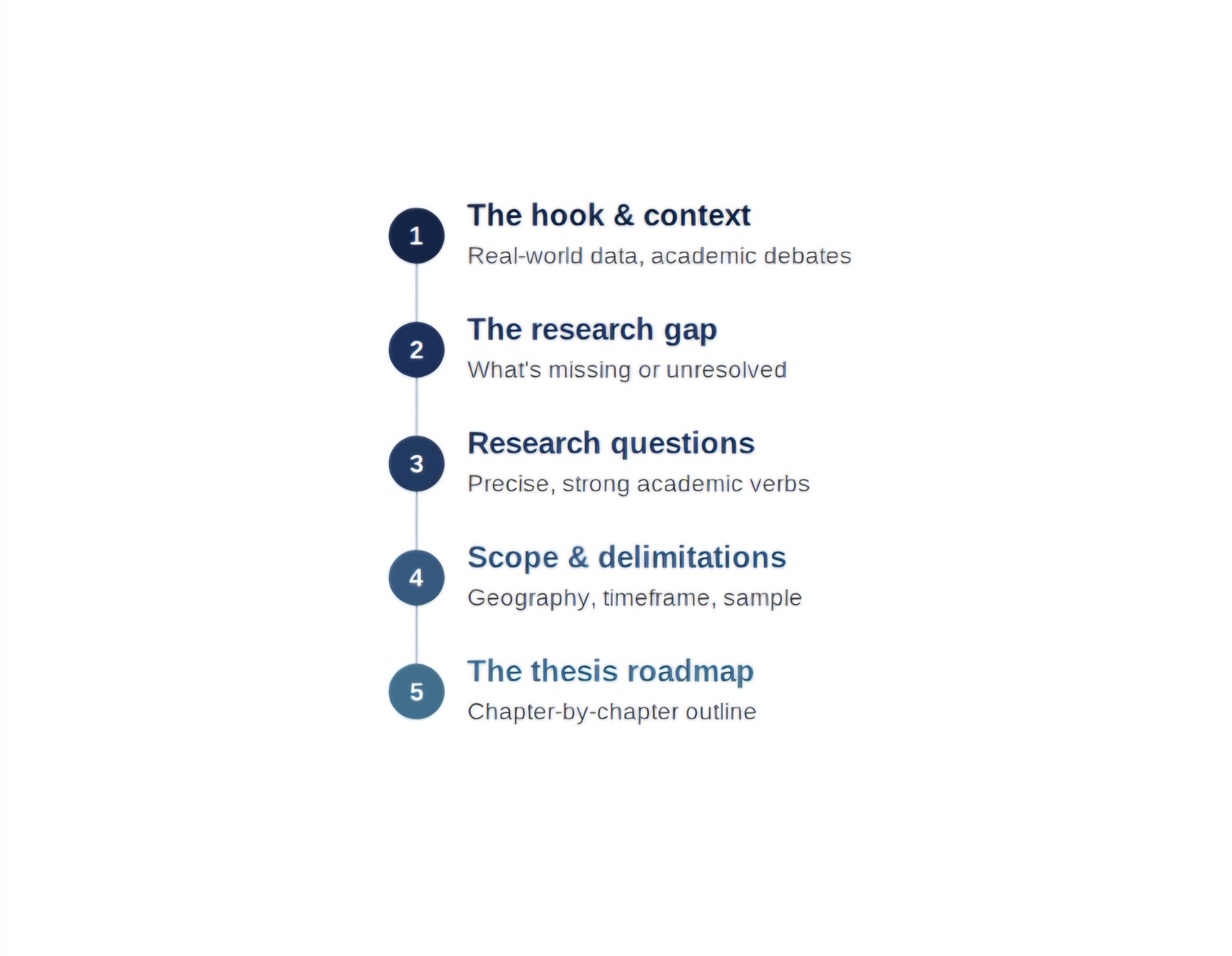
Step 1: Hook the Reader Without Using Clichés
Your opening paragraphs must establish the relevance of your field. You want to show the reviewer that your topic is active, heavily debated, or practically significant right now.
However, avoid the classic traps that signal amateur writing. Never start a master’s thesis with sweeping, fluff-filled phrases like "In today’s fast-paced modern world..." or "Since the beginning of recorded history...". University professors read those lines hundreds of times a year, and they instantly lower the perceived value of your paper.
Instead, start directly with verified context. Mention a recent shift in industry standards, quote a core theoretical debate from the last two years, or cite baseline statistical data. Grounding your very first sentence in real-world evidence proves that you are treating your research seriously from word one.
Step 2: Uncover the Research Gap (The Theoretical Heart of Your Paper)
Once you have set the stage, you need to transition from what the academic world already knows to what it doesn't know yet. This missing piece is what scholars call the research gap.
Without a clearly articulated research gap, a thesis risks reading like an oversized high-school report—a mere summary of other people's work. To earn a high grade, your paper must contribute something new, even if that contribution is small.
To find and explain your gap, ask yourself these critical questions:
Is current research on this topic outdated because technology or society has shifted?
Did previous researchers focus only on one geographical region or industry, leaving your specific context unexplored?
Do two major theoretical models contradict each other when applied to your specific scenario?
When you explicitly highlight this missing knowledge, you give your paper a clear purpose. You are no longer just writing a paper because your university requires it; you are writing it to solve a real intellectual blind spot.
Step 3: Frame Your Research Questions With Surgical Precision
Now that you have proven a problem exists, your research questions arrive as the direct solution.
This is where language precision becomes critical. Avoid vague phrasing like "This paper will look into..." or "I want to discuss how X works." Academic evaluators want to see strong, targeted verbs that define clear boundaries. Use terms like quantify, evaluate, delineate, synthesize, or compare.
A good golden rule for a master’s thesis is to craft one primary research question supported by two to four sub-questions. If you try to answer ten different questions in a single paper, you will end up skimming the surface of all of them. Keeping your scope focused shows maturity and discipline.
Step 4: Draw Your Boundaries (Scope and Delimitations)
Just as important as stating what you will study is stating what you will not study. This is known as setting your delimitations.
Explicitly declaring your scope boundaries is actually a clever defensive move for your thesis defense. If you state in Chapter 1 that your study is strictly limited to mid-sized European tech firms between 2020 and 2025, an evaluator cannot penalize you for not including data from Asian startups or historical data from 2010.
Defining your boundaries protects your workload and shows the committee that you understand the realistic limits of a university research project.
Step 5: Outline the Roadmap
Finish your introduction chapter with a clean, clear roadmap of the rest of the document. Briefly walk the reader through what is coming in Chapter 2 (Literature Review), Chapter 3 (Methodology), Chapter 4 (Findings), and Chapter 5 (Discussion and Conclusion).
This structural signposting acts like a mental GPS for your reviewer. When they know what to expect in the coming chapters, they can process your arguments much faster and with far less cognitive fatigue.
Putting It All Together: A Real-World Example
To see how these five steps fit together seamlessly in an actual manuscript, consider this example of a well-structured introduction paragraph sequence for a master’s thesis in Business & Sustainability:
Step 1 - The Hook: Over the past five years, European manufacturing companies have faced growing pressure to adopt circular economy practices. According to recent Eurostat data, more than 68% of mid-sized industrial enterprises have introduced resource-recycling targets to meet updated EU sustainability guidelines.
Step 2 - The Research Gap: However, while existing research extensively covers the broad economic benefits of circular supply chains, very few studies examine how these requirements affect the day-to-day profitability of family-owned manufacturing SMEs.
Step 3 - Research Questions: To fill this gap, this thesis examines the link between circular transition costs and profit margins in European SMEs. Specifically, this study answers one primary research question: How does adopting closed-loop recycling systems affect the two-year ROI of mid-sized industrial firms?
Step 4 - Scope & Delimitations: To keep the analysis focused, this research is limited to automotive component suppliers in Germany and Sweden between 2022 and 2025, excluding service-based companies.
Step 5 - The Roadmap: This thesis is divided into five chapters. Chapter 2 reviews the theoretical background on corporate sustainability. Chapter 3 explains the quantitative survey design and data analysis. Chapter 4 presents the main findings, and Chapter 5 concludes with practical recommendations for business managers.
The Unspoken Struggle: Overcoming Text Blindness
Here is a reality that every thesis writer faces eventually: after you spend weeks or months staring at the exact same draft, your brain stops reading what is actually on the screen and starts reading what you think you wrote.
This phenomenon is called text blindness. Your brain gets so familiar with your own logic that it automatically skips past typos, ignores awkward sentence flow, and fills in missing logical steps without you realizing it.
Unfortunately, your thesis evaluator does not have that same familiarity. They will read your paper with fresh, critical eyes. Minor grammatical slips, inconsistent terminology, or clunky transitions can distract them from the brilliant research you worked so hard to produce.
This is why setting your draft aside for a few days before editing is crucial. Even better, having an objective, professional academic proofreader review your manuscript can make all the difference. An experienced external eye can catch stylistic ambiguities, refine your academic tone, and polish your introduction until it reads like an authoritative, publication-ready piece of scholarship.
Final Thoughts
Writing a master’s thesis is a marathon, not a sprint, and Chapter 1 is where you set your pace. By taking the time to build a logical funnel, clearly define your research gap, and polish your academic tone, you set a gold standard for the rest of your paper.
Take it one section at a time, keep your scope focused, and trust the structure. You’ve got this!
Need an Extra Pair of Eyes on Your Draft?
Even the most well-structured introduction can suffer from text blindness. Before you submit Chapter 1 to your supervisor, explore our Services page to see how Lumina Proofreading & Editing can help refine your tone, eliminate hidden errors, and ensure your research gap shines with complete clarity.
Ready to polish your thesis? Get your free proofreading quote today!