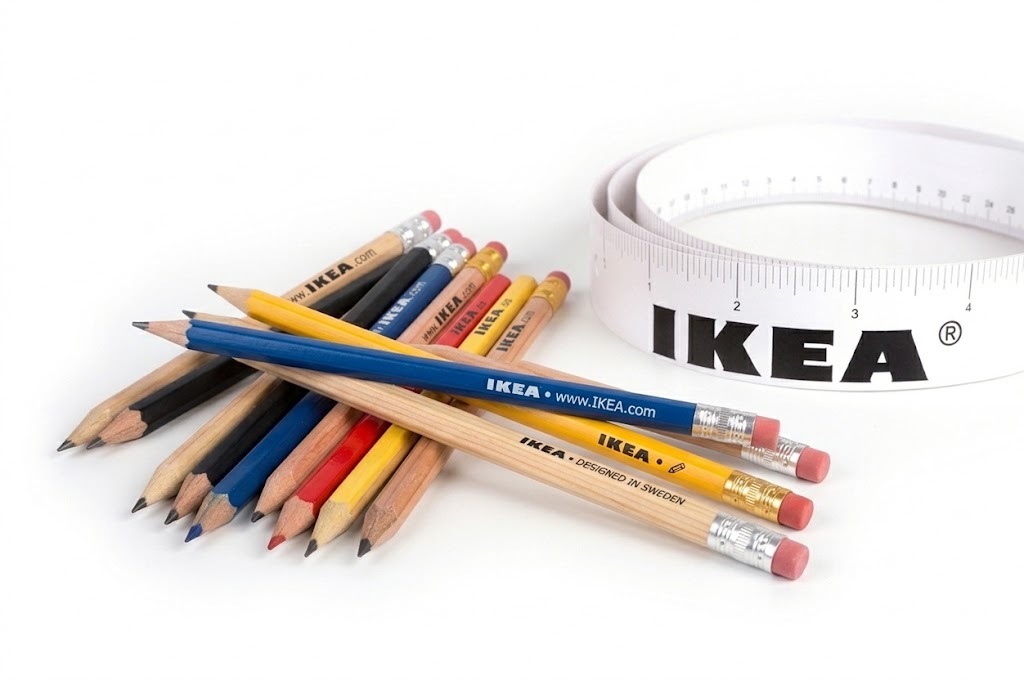
In 2011, a team of behavioral economists from Harvard, Yale, and Tulane published a now-famous series of experiments. They asked participants to assemble simple IKEA coffee tables, fold origami figures, or build Lego structures. Afterwards, the researchers asked the participants to place a monetary value on their creations.
The results were remarkable: participants consistently valued their own slightly crooked, DIY items almost as much as expert-built furniture. More surprisingly, they genuinely expected other people to share their passion and see the high value in their creation.
Psychologists labeled this phenomenon the IKEA Effect: a cognitive bias where people attribute a disproportionately high value to products or outcomes they personally labored over.
While this bias is harmless when applied to a wobbly bookcase in your living room, it is one of the most destructive hidden forces in academic writing.
The Hidden Cost of "Hard-Earned" Words
Writing a master’s thesis, a PhD dissertation, or a journal article is an exhausting process. You spend days deciphering dense methodology papers, weeks wrestling with statistical models, and late nights trying to make sense of ambiguous data.
When you finally squeeze all that frustration into a couple of pages, you naturally get attached. You suffered for them. You spent six hours in the library writing three paragraphs.
The core problem? Labor does not equal clarity.
Because of the IKEA Effect, when you re-read your draft, your brain doesn't evaluate the text objectively. Instead, it measures the effort you invested in producing it:
The unnecessary literature review: You spent three full days understanding a complex theoretical framework that ultimately turned out to be irrelevant to your core hypothesis. But because you worked so hard to grasp it, you force a three-page summary of it into Chapter 2 anyway.
The over-engineered sentence: You spent twenty minutes trying to stitch four complex ideas into one grand, five-line sentence. Even though it reads like a grammatical labyrinth, you refuse to break it up because you feel proud of having glued it together.
The structural fluff: You added three extra paragraphs of broad contextual commentary just to reach a word-count milestone. Deep down, you know it is filler, but you cannot bear the thought of watching your document length shrink after hours of typing.
To you, those paragraphs represent hard-earned progress. To a reviewer, professor, or peer-examiner, they represent cognitive friction—unnecessary noise that masks the true value of your findings.
Why Academic Reviewers Hate Your "IKEA Paragraphs"
When a journal reviewer or committee member evaluates your paper, they are reading with a limited budget of mental energy. Every time they encounter a sentence that requires a second read-through, a fraction of their attention is lost.
If your draft is filled with hard-earned but unnecessary text, three things happen:
Your core contribution gets buried: When key insights are surrounded by fluff, the reader misses the originality of your research.
Your logic feels fragmented: Over-complicated sentences disrupt the narrative thread, making it seem as if your methodology or arguments are flawed when the real issue is simply bad sentence flow.
Reviewer fatigue sets in: A tired reviewer is a critical reviewer. When reading becomes a chore, acceptance rates drop, and revision requests multiply.
"Kill Your Darlings": 4 Strategies for Ruthless Self-Editing
William Faulkner famously advised writers to "kill your darlings"—meaning you must be willing to cut out your absolute favorite, most elaborate sentences if they do not serve the overall document.
In academic editing, cutting text does not mean discarding your intellect. It means clearing away the conceptual props so your final conclusions can shine.
Here is how to detach emotionally from your draft and edit with cold, professional objectivity:
1. The "Graveyard Document" Technique
The primary reason researchers hesitate to delete a heavy paragraph is the fear of losing their hard work forever.
Before you begin editing, open a separate blank document and name it "thesis_graveyard.docx." Whenever you find a sentence or section that feels clunky or redundant, do not delete it—cut and paste it into the graveyard document.
Knowing your text is safely archived removes the emotional friction of editing. Paradoxically, once those paragraphs are stored away, you will almost never go back to retrieve them.
2. The "So What?" Test
Read through your draft paragraph by paragraph, pausing at the end of each one to ask yourself a direct question: "So what?"
Does this paragraph directly advance my central research question?
Is this specific citation clarifying my methodology, or am I just proving that I read the source?
If a reader completely skipped this section, would the logical flow of my paper break down?
If the answer to the last question is "no," the paragraph is structural fluff. Move it straight to your graveyard document.
3. Sentence Rhythm: The 20-Word Reset
A common symptom of the IKEA Effect is the endless compound sentence. When trying to explain a complex topic, we stack relative clauses using which, where, furthermore, and in order to.
To restore rhythm, scan your paragraph for sentence length. Pair a long, analytical statement with a short, punchy sentence:
Before (monotonous & dense): Although initial quantitative surveys indicated a sharp decline in participant engagement across secondary demographics, subsequent qualitative interviews revealed that this shift was primarily driven by interface friction rather than a fundamental lack of interest in the underlying platform features.
After (dynamic & clear): Initial survey data showed a sharp drop in participant engagement. However, follow-up interviews revealed a different picture: users valued the platform's core features, but encountered significant friction with its interface.
Notice how the second version delivers the exact same academic insight, but with double the impact and half the reading effort?
4. Read the Text Backwards
When reading your work from start to finish, your memory of what you meant to write fills in missing logical steps.
To break this habit, read your draft one paragraph at a time, starting from the conclusion and working backward to the introduction. Isolating each paragraph forces you to evaluate its clarity on its own, without relying on your memory to fill in the blanks.
You Built It—Now Let Someone Else Polish It
The ultimate paradox of the IKEA Effect is that you are inherently the worst judge of your own draft's readability.
Because you lived through the research process, your brain automatically smooths over awkward transitions, implicit assumptions, and dense phrasing. You hear the full symphony in your head, even when the notes on the page are out of alignment.
This is why top academics and graduate researchers never rely on self-editing alone.
At Lumina Proofreading & Editing, we offer an expert, objective second look at your draft. Beyond basic spellchecks, we trim fluff, fix sentence flow, and polish your writing so your research comes through clearly—all while keeping your own academic voice.
Curious how much clearer your draft could sound with a professional polish? Visit the Services page to learn more about the editing process, or head to Quotes for an instant estimate.